

In purpose-driven organisations, the internal environment matters as much as the external mission. The way staff experience work every day shapes the quality of care, service and support delivered to the community.
A healthy internal environment supports staff wellbeing, strengthens service consistency, and ultimately protects long-term organisational impact.
Yet many organisations still view the intranet as a secondary system — a place to store files or post announcements.
A modern intranet deserves a different framing: it is the foundation of a human-centred digital workplace.
Not a file server. Not a noticeboard. An environment that shapes how people feel, function and contribute at work.
Employee Experience is Built in the Everyday
Employee experience today is not defined by perks or workplace programs alone.
It is defined by whether people feel:
- connected to purpose
- informed and capable
- supported by their organisation
- able to do their work without unnecessary friction
Experience spans the entire employee lifecycle from onboarding through daily collaboration, decision-making and transition.
In that context, the intranet becomes more than a platform. It becomes the backbone of how people navigate work.
Clarity Reduces Cognitive Load and Stress
In many community and NFP environments, staff are stretched. Time and emotional energy are precious.
But unnecessary friction compounds quickly:
- searching for the right policy
- navigating inconsistent project spaces
- duplicating work
- unclear ownership
- repeated interruptions for basic answers
This creates cognitive overload and over time, disengagement and burnout.
A well-designed intranet reduces that burden by making knowledge easier to access, structures predictable and communication consistent.
Access to information is not just efficiency. It is relief.
“Not Having to Ask” is a Form of Dignity
One of the most underestimated outcomes of good internal systems is autonomy.
When employees can find what they need without having to interrupt others or rely on informal gatekeepers, they feel trusted and respected.
This aligns with research on empowerment. Spreitzer’s work shows that access to information and autonomy improves job effectiveness and motivation (Spreitzer, 1995).
In practice, clarity becomes dignity: people are supported to do their work without constantly having to ask.
Psychological Safety is Supported by Organisational Design
High-performing teams are not only talented, but they also operate in environments where people feel safe to contribute, ask questions and learn.
Amy Edmondson’s research on psychological safety demonstrates that teams perform better when individuals feel safe to speak up and participate (Edmondson, 1999).
Digital workplace design plays a role here.
When expectations, processes, and knowledge are accessible, staff are less exposed to interpersonal risk and more able to focus on meaningful work.
Support is Experienced Through Everyday Systems
Staff commitment is shaped not only by leadership intention, but by consistent daily signals.
Research on perceived organisational support shows that when employees feel supported, effort and commitment increase (Eisenberger et al., 1986).
Support is not only expressed through values statements.
It is experienced through:
- clear internal communication
- accessible knowledge
- reliable systems
- reduced frustration
- feeling set up to succeed
The intranet becomes a quiet but powerful expression of organisational care.
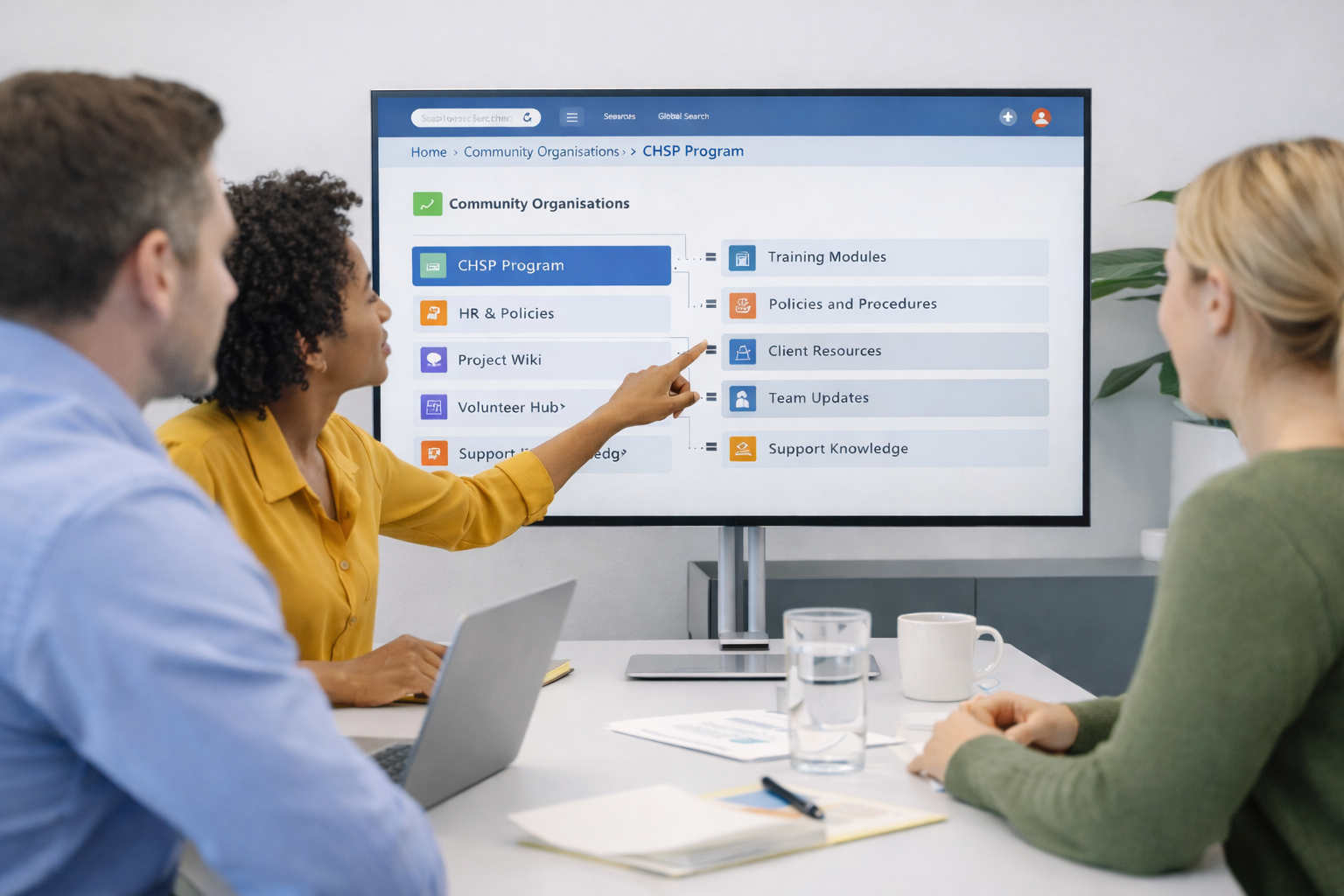
Case Example: Restoring Confidence Through Internal Clarity
A mid-sized community-focused organisation recently found that staff were spending too much time navigating internal confusion.
Project documentation was fragmented across Teams and SharePoint sites. Policies were difficult to locate. New staff felt overwhelmed. Teams were relying heavily on “asking around” just to get basic answers.
Rather than starting with technology, the organisation began with a simple question:
What does staff clarity need to look and feel like?
The work focused on:
- simplifying the structure of project and operational content
- creating consistent navigation across sites
- establishing clear “source of truth” spaces for key knowledge
- reducing duplication and version confusion
- designing the intranet experience around frontline needs, not corporate broadcasting
Within weeks, staff reported less friction, fewer interruptions and greater confidence in finding what they needed independently.
The outcome wasn’t just a cleaner intranet environment.
It was a workplace that felt more supportive.
Internal Clarity Enables External Consistency
This is especially important in community services.
When internal systems are unclear, inconsistency eventually reaches clients and communities:
- mixed interpretations of policy
- uneven service delivery
- confusion across teams
- reduced trust
Internal clarity strengthens external reliability.
A strong intranet helps organisations deliver consistent service because staff are aligned, informed, and supported.
Intranet + Culture is a Sustainable Advantage
The strongest organisations will not simply be those with more tools.
They will be those that create environments where people feel:
- empowered
- connected
- safe
- capable
- proud of their contribution
A modern intranet is where culture becomes operational.
Where knowledge becomes shared.
Where support becomes tangible.
Where people experience purpose with less friction.
In mission-led work, that is not a technical upgrade.
It is a sustainability strategy.
A Leadership Question Worth Asking
The question is not whether your organisation has an intranet.
The question is:
Does your internal environment help people do their best work or make it harder than it needs to be?
When designed as a foundation for clarity, dignity, and connection, the intranet becomes far more than a digital platform.
It becomes part of how organisations care for their people and in turn, how they care for their communities.
Read more about Gorica Mitrovic
References:
Spreitzer, G. M. (1995). Psychological empowerment in the workplace: Dimensions, measurement, and validation. Academy of Management Journal, 38(5), 1442–1465. https://doi.org/10.2307/256865
Edmondson, A. C. (1999). Psychological safety and learning behavior in work teams. Administrative Science Quarterly, 44(2), 350–383. https://doi.org/10.2307/2666999
Eisenberger, R., Huntington, R., Hutchison, S., & Sowa, D. (1986). Perceived organizational support. Journal of Applied Psychology, 71(3), 500–507. https://doi.org/10.1037/0021-9010.71.3.500


